
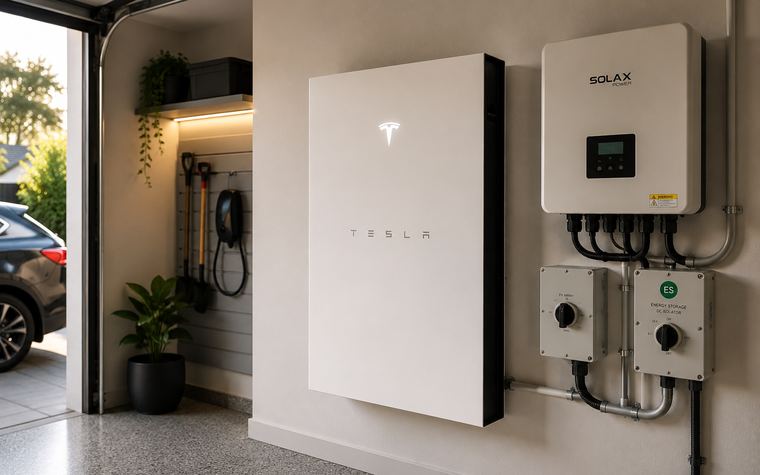
Solar Battery Storage
Use the power you generate instead of selling it cheaply and buying it back at retail.
Federal Battery Rebate
The same battery costs more the longer you wait
The federal battery discount comes off your quote upfront. Since 1 May 2026 it steps down every six months rather than annually, and it tapers on larger batteries.
There is no penalty for asking early. We will tell you what you qualify for today and what that same system would cost after the next step down, so you can decide on real numbers rather than pressure.
Indicative rate remaining, by year
- 2026Available now
- 2027
- 2028
- 2029
- 2030
Shape is indicative. We confirm the exact figure that applies to your install at the time of quoting.
What A Battery Does
Three things change the day it is fitted
Solar without storage sends your surplus to the grid for a few cents and sells it back to you at full price after dark. A battery closes that gap.
Your evening runs on your own power
The peak block between about 4pm and 9pm is when your household uses most and when grid power costs most. A battery covers that window with electricity you already generated.
You stop exporting cheaply
Feed-in tariffs have fallen well below what you pay to buy power back. Every kilowatt-hour you store and use is worth several times what you would have been paid to export it.
Chosen circuits stay on in an outage
Solar alone shuts down in a blackout for safety reasons. With backup wired in, nominated circuits keep running. Which circuits is a decision we make with you, not an assumption.
Backup
What “backup” actually covers
This is the part most often misunderstood. A home battery does not usually run your whole house through an outage. It runs an essential circuits sub-board that we set up during the install.
Typically that means lights, power points, the fridge, and your internet. Large loads such as ducted air conditioning, electric hot water, ovens and pool pumps are normally left off it, because running them would empty the battery in under an hour.
We agree the list with you before installation and label the switchboard so you know exactly what stays on. If you want more than the usual set, that is a design conversation, not a surprise on the day.
Sizing
Sized to your evening, not to a number
We work from your actual bills and, where available, your smart meter data. A battery that is too big never fully cycles and never pays for itself.
What you use after dark
Your bills show total consumption. Interval data shows how much of it lands after sunset. That evening figure is what the battery has to cover.
What your solar has spare
There is no point storing more than your array produces beyond your daytime use. If the surplus is small, the honest answer may be more panels before a battery.
What you want backed up
If outage backup matters to you, the essential circuits list affects capacity. Wanting the fridge to survive a storm is a different spec from wanting to shave a bill.
Existing Solar
Adding a battery to solar you already have
Usually possible. Whether it is straightforward depends on your existing inverter and how the battery couples to it.
An AC-coupled battery sits alongside your current system with its own inverter, so your existing gear stays as it is. A DC-coupled battery is more efficient but generally needs a compatible hybrid inverter, which may mean replacing what you have.
We check your inverter, switchboard and meter at the site assessment and tell you which applies before you commit either way. If your existing system is close to end of life, we will say so rather than bolt a new battery onto something that needs replacing.
What we check before quoting
- Existing inverter
- Make, age, hybrid capable
- Switchboard
- Space and condition
- Supply
- Single or three phase
- Meter
- Type and reconfiguration needed
- Location
- Wall space, ventilation, access
- Usage
- Recent bills and interval data
All of this is covered in the free site assessment. There is no obligation and no deposit.
Straight Answer
Is a battery worth it for your household?
Not for everyone, and we would rather tell you that at the assessment than after the install.
Usually worth it
- You use a lot of power in the evening
- Your solar exports a large surplus most days
- Outages in your area genuinely disrupt you
- You have an EV, or expect one soon
Worth a longer think
- Your household is out all day and uses little at night
- Your existing array is small and rarely exports
- You are moving house within a few years
- Adding panels would save you more for the same spend
Batteries We Install
We fit tier-one storage from manufacturers with an Australian presence, so a warranty claim has somewhere local to go. Which one suits you depends on your inverter, your capacity and your backup needs.



FAQ
Batteries, answered.
Typically ten to fifteen years depending on how hard it is cycled. Warranty terms differ by manufacturer, so rather than quote a general figure we give you the exact warranty for the battery you are actually buying, in writing, with the quote.
Normally no, and any installer who says otherwise is worth questioning. Backup runs a nominated set of essential circuits. Large loads like ducted air conditioning or electric hot water would drain a home battery in well under an hour.
Yes. We wire every solar system so a battery can be added later without replacing the inverter. The trade-off is the rebate: it steps down every six months, so waiting costs more than it used to.
Very little. It is sealed and self-managing. Your monitoring app shows charge and discharge each day, so a drop in performance is easy to spot early. We are on the end of the phone if a reading ever looks wrong.
Usually a garage or an external wall in shade, with clearance for ventilation and access. Heat shortens battery life, so a west-facing wall in full afternoon sun is a poor choice even where it looks tidiest. We work the location out with you on site.
Barely. Most home batteries produce a low hum from cooling fans under heavy load, comparable to a fridge. It is worth considering if the only sensible wall is next to a bedroom.
Get Started
Find out what a battery would actually save you
Send us a recent bill. We will model your evening usage, tell you the rebate that applies today, and give you an honest answer on whether storage is worth it for your household.
Rebate amounts and performance figures vary by site and change over time. Please speak to West Vic Energy for figures that apply to your property.